The Next Evolution of Lightweight Backcountry Aviation.
Reserve a Production Position if in Kentucky, North Carolina, South Carolina, Tennessee, Virginia, West Virginia.
The Carbon Cub ULT is the world’s first regenerative turbine-powered backcountry aircraft and the first US manufactured turbine aircraft that Light Sport pilots can fly. It combines the legendary backcountry performance that made the Carbon Cub famous with the simplicity, smoothness, safety, reliability, and fuel flexibility of a modern turbine engine. It starts with the push of a button, uses a single power lever, burns Jet-A or diesel, and already more static thrust, better climb, and faster cruise than the original Carbon Cub.
At the heart of the Carbon Cub ULT is the innovative TurboTech TP-R90 regenerative turboprop engine. Featuring a dual FADEC (Full Authority Digital Engine Control) system, the aircraft delivers push-button starting, single-lever power management, and turbine smoothness without the complexity traditionally associated with turbine aircraft. By automatically managing fuel flow, ignition, temperatures, and propeller operation, the ULT allows pilots to focus on flying rather than engine management. The regenerative turbine design also achieves fuel efficiency comparable to modern gasoline-powered aircraft while offering the durability, reliability, and simplicity turbine operators value.
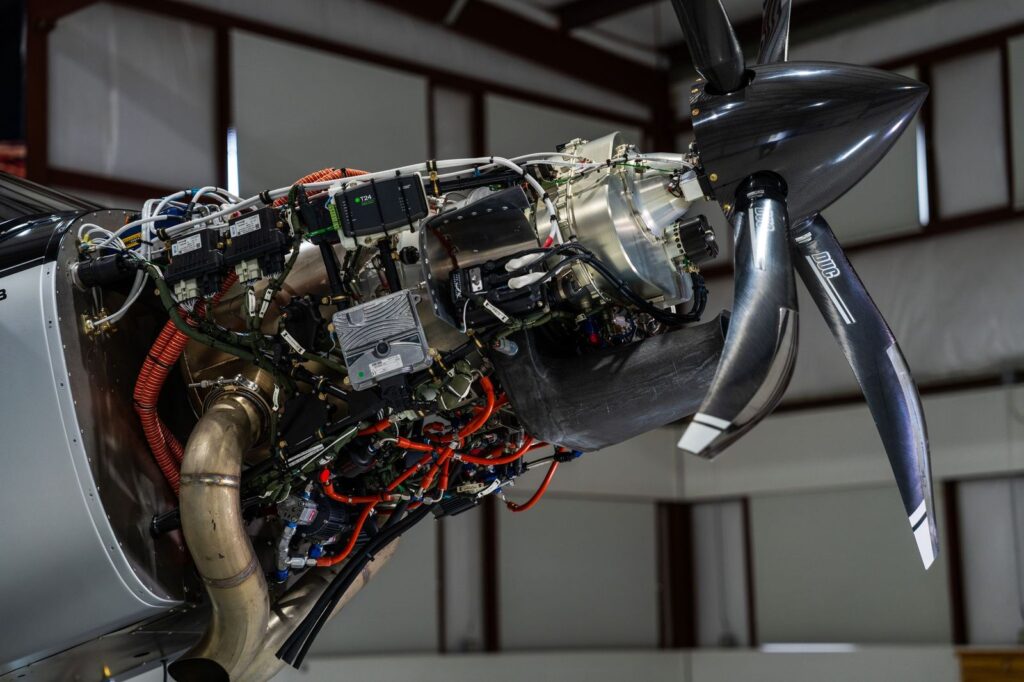
The Carbon Cub ULT combines this advanced propulsion system with CubCrafters’ latest generation of lightweight composite construction, aerodynamic refinements, and proven STOL capability. The result is an aircraft that delivers exceptional backcountry performance while offering one of the simplest operating experiences in aviation. From startup to shutdown, the aircraft is designed to reduce pilot workload and increase confidence, making turbine technology more accessible than ever before. As the first U.S.-manufactured turboprop aircraft eligible to be flown by Sport Pilots under the FAA’s new MOSAIC regulations, the ULT marks a significant milestone in recreational aviation.
Aircraft
| Certification | Light sport |
| Factory builder assist (E-AB) | |
| Type | Single engine land and sea |
| Crew | 2 |
Powerplant
| Engine | TurboTech TP-R90 / R150 |
| Propeller | Variable pitch |
Dimensions
| Length | 23 ft 3 in |
| Height | 8 ft 4 in |
| Wingspan | 34 ft 3 in |
| Wing area | 179 sq ft |
| Cabin width | 30" at pilot position |
| Cabin height | 52" at pilot position |
Weights
| Empty weight | 880 lbs est. |
| Gross weight | 1,865 lbs |
| Useful load | 985 lbs est. |
Capacities
| Fuel | 44 gallons |
Performance
| Cruise speed | 130+ mph est. |
| Stall speed | 32 mph |
| Endurance | 5.2 hrs est. |
| Range | 682 miles est. |
| Takeoff distance | 50 ft* |
| Landing distance | 90 ft* |
*Performance numbers assume optimal conditions, actual numbers will vary. Fuel consumption and speed will vary with power settings.
The Carbon Cub ULT is designed to operate primarily on Jet-A fuel, although the TurboTech engine is capable of operating on multiple fuel types including diesel.
Yes.
The pilot starts the engine with the push of a button and controls power with a single lever. The dual-redundant FADEC automatically manages the engine throughout the flight, allowing the pilot to focus on flying.
No.
The Carbon Cub ULT was designed to make turbine ownership approachable, with push-button start, Jet-A fuel, and dual-redundant FADEC simplifying operation.
A tailwheel endorsement is necessary, but no type rating or special turbine rating is required. Appropriate transition training is always recommended.
Insurance requirementsare determined by the insurer.
No.
While the Carbon Cub ULT is the first application of the TurboTech TP-R90 in a backcountry airplane, the engine itself represents the multiple generations of testing and refinement of TurboTech’s regenerative turbine technology.
Is this just a “cool factor” airplane?
Absolutely—the cool factor is real. We believe the Carbon Cub ULT is one of the most exciting new aircraft introductions in decades.
Beyond that, the real advantages are simpler operation, reduced pilot workload, turbinereliability, fuel flexibility, smooth operation, and longer engine life.
Reserve a Production Position if in Kentucky, North Carolina, South Carolina, Tennessee, Virginia, West Virginia.